

7 Essential AI Solutions That Will Transform Your Business in 2026: Top AI Tools and Strategies for Enterprise Growth
Introduction
Artificial Intelligence (AI) solutions are software systems that apply machine learning, natural language processing, computer vision, and automation to generate business value by improving decisions, processes, and customer experiences. In 2026, rapid improvements in generative models, real-time inference, and low-code deployment make AI for business productivity and enterprise AI platforms more accessible and impactful than ever. This article explains seven essential AI solutions, shows how they map to core technologies like ML, NLP, CV, and RPA, and provides practical guidance for selection, implementation, and measurement. Readers will gain a prioritized list of solutions, measurable KPIs, implementation checklists, ethical checkpoints, and SMB-specific playbooks to start producing ROI quickly. Each H2 section below answers a common commercial or operational question with actionable steps, compact EAV comparison tables, and vendor-selection thinking to help teams evaluate AI software solutions for their organization. Current research and market signals as of 10/2025 are woven throughout to keep recommendations timely and applicable.
What Are the 7 Essential AI Solutions Driving Business Transformation in 2026?
AI solutions encompass discrete categories that resolve specific business challenges by combining data pipelines, trained ML models, and deployment pipelines into production software. These solutions improve efficiency, reduce costs, increase revenue, and enhance customer experience by automating decisions, predicting outcomes, and generating content. Below is a numbered list with one-line definitions optimized for quick decision-making and featured-snippet clarity.
- AI Chatbot & Conversational AI: Automates customer interactions using NLP and dialogue management to increase support capacity and reduce response times.
- Predictive Analytics & Forecasting Platforms: Use ML models and time-series forecasting to predict demand, churn, and financial outcomes for proactive planning.
- Computer Vision Systems: Apply CV models to analyze images and video for quality control, visual inspection, and retail analytics.
- Robotic Process Automation (RPA) with AI: Combines RPA and ML to automate rule-based tasks and unstructured data processing for back-office efficiency.
- Generative AI & Content Automation: Leverages large models to create text, images, and code for marketing, documentation, and rapid prototyping.
- AI-Driven Personalization Engines: Use recommendation algorithms and real-time scoring to tailor customer experiences across channels.
- AI-Powered Talent and HR Platforms: Use NLP and ML for candidate matching, skills mapping, and personalized learning to optimize workforce outcomes.
Which AI technologies power these essential solutions?
AI technologies such as machine learning, natural language processing, computer vision, generative AI, and RPA each provide distinct mechanisms that enable the seven solutions above. ML provides predictive patterns from historical data, NLP enables intent recognition and entity extraction for conversational systems, and CV interprets pixels for automated inspection and surveillance. Generative AI synthesizes novel content and prototypes from learned distributions, while RPA orchestrates workflows and integrates with enterprise systems. Mapping technologies to solutions clarifies vendor selection and implementation sequencing for data, model training, APIs, and deployment pipelines.
How do these AI solutions impact different business functions?

AI solutions influence marketing, sales, operations, HR, finance, and supply chain by automating routine work, enhancing decision speed, and surfacing predictive insights. For marketing and sales, personalization engines and generative content increase conversion rates and reduce creative cycle times; in operations, predictive maintenance and forecasting reduce downtime and inventory costs. HR benefits from automated screening and adaptive learning, while finance gains faster anomaly detection and forecasting that improve cash flow management. These cross-functional impacts create multiplier effects when integrated into existing systems like CRM and ERP.
What measurable benefits do businesses gain from adopting these AI solutions?
Organizations typically measure AI impact through KPIs such as cost reduction, time saved, conversion uplift, error rate decline, and increased revenue per customer. For example, RPA with AI can reduce processing time for invoicing by 40–70% and computer vision inspection can lower defect rates by 20–50% depending on context. Predictive analytics often improves forecast accuracy by 10–30%, which translates into inventory savings and revenue retention. Tracking baseline metrics and using controlled pilots ensures attribution and realistic ROI expectations.
Intro to comparison table for quick scanning
How to choose a vendor (selection criteria)
Choosing a vendor requires assessing integration capability, model explainability, data security, scalability, and support for deployment pipelines. Prioritize vendors that offer demos or trial environments, transparent model performance metrics, and clear data governance controls. Consider vendors with low-code/no-code interfaces for faster time-to-value and those that provide monitoring and observability for models in production. Evaluating these attributes through a short vendor RFP and trial will surface technical fit and operational readiness.
How Does AI Enhance Customer Engagement and Service in 2026?
What role do AI chatbots and NLP play in improving customer service?
AI chatbots use intent classification, entity extraction, and multi-turn dialogue to resolve common inquiries and escalate complex issues to humans when needed. Modern chatbots support voice and text, integrate with backend systems for identity and order lookups, and track metrics like deflection rate, average handle time, and CSAT. Although chatbots automate many flows, well-defined escalation rules and human-in-the-loop monitoring are essential to maintain quality. Evaluating chatbot platforms on intent coverage and integration depth informs deployment decisions.
How does AI-driven personalization boost marketing and sales?
Personalization engines use recommendation algorithms, segment scoring, and contextual signals to present relevant products, offers, and content, increasing conversion rates and average order value. These systems rely on merged customer profiles, session data, and ML-based scoring to deliver dynamic experiences across web, email, and app channels. Implementing personalization requires instrumentation for A/B testing and measuring uplift in CTR and revenue per visitor. Best practices include starting with a single-use case and iterating based on measured lift.
Research indicates that AI-driven personalization can significantly enhance customer experiences by tailoring offerings to individual preferences.
AI-Driven Personalization for Enhanced Customer Experiences
The purpose of this research study is to investigate how AI-driven-personalization chatbots and virtual assistants might improve customer experiences across different types of businesses. It investigates if artificial intelligence is able to cater goods, services, and marketing to the preferences of customers. The areas of retail and hospitality, together with finance, are the primary emphasis of this article. This study investigates the ways in which artificial intelligence can improve retail virtual shopping assistants and product recommendations. This article investigates the use of artificial intelligence (AI) chatbots in the hotel industry to give individualized booking experiences and recommendations. This study investigates the ways in which artificial intelligence-driven communications and individualized financial advice can improve customer service. Through the use of case studies and data analysis, the author of this study analyzes the practical uses of AI-powered per
The role of AI-Enhanced personalization in customer experiences, MS Bhuiyan, 2024
Which AI tools enable predictive customer insights and relationship management?
Predictive customer tools include platforms that provide segmentation, churn scoring, LTV forecasting, and propensity models integrated with CRM workflows. Key attributes to evaluate are real-time scoring, model explainability, supported data sources, and the ability to operationalize predictions through marketing automation. Integration ease with existing CRM and customer data platforms is critical for adoption and for deriving action from predictions. Teams should validate models on historical data and use controlled rollouts to measure impact.
AI-driven personalization yields these common business outcomes:
- Improved conversion and retention through targeted offers and content.
- Faster support resolution and reduced support costs via automatic handling.
- Increased revenue by identifying high-LTV customers and prioritizing engagement.
These outcomes highlight how personalization and predictive insights form a feedback loop that enhances both experience and bottom-line performance.
How Can AI-Powered Automation Improve Operational Efficiency?
What are the key features of AI automation solutions for businesses?
AI automation solutions should include orchestration, vision/ML integration, low-code builders, monitoring dashboards, and governance controls to ensure safe operation. Orchestration enables end-to-end process control, while model monitoring detects drift and performance degradation. Low-code features shorten development cycles and allow business users to author workflows, but robust governance is required to manage permissions and audit logs. Selecting automation tools with these features reduces technical debt and accelerates scaling.
Intro to automation comparison table
How does AI optimize supply chain management and logistics?
AI optimizes supply chain through demand forecasting, route optimization, inventory balancing, and predictive maintenance using time-series models and optimization algorithms. Demand forecasting improves replenishment decisions, reducing stockouts and overstock, while route and capacity optimization lower transportation costs and delivery times. Predictive maintenance uses sensor data and ML to schedule repairs before failures, decreasing downtime and extending asset life. Pilots that measure forecast accuracy changes and transportation cost per unit deliver clear evidence for scale-up.
What impact does AI have on data analytics and business insights?
AI accelerates analytics with AutoML, anomaly detection, and automated insight generation that reduce time-to-insight and democratize data-driven decisions. AutoML automates model building while explainability tools surface the drivers behind predictions, improving trust and adoption. Anomaly detection highlights operational issues faster than manual review, enabling quicker remediation. Organizations should track time-to-insight and decision lead time as primary metrics for analytics ROI.
What Are the Top AI Solutions Transforming Human Resources and Workforce Management?
How does AI streamline recruitment and talent acquisition?
AI streamlines recruitment through résumé parsing, skill matching, and automated scheduling, reducing time-to-hire and improving candidate fit. NLP extracts structured attributes from resumes and forms, while scoring models rank candidates against job success predictors. Bias mitigation requires careful feature selection, fairness testing, and human oversight in decision loops. Quick wins include automated interview scheduling and targeted outreach to qualified passive candidates.
In what ways does AI support employee engagement and performance management?
AI identifies engagement signals by analyzing survey responses, communication patterns, and performance metrics to surface attrition risk and development needs. Sentiment analysis and trend detection pinpoint issues early, enabling targeted coaching and personalized development plans. Performance prediction models help managers allocate training resources to high-impact employees, improving productivity and retention. Tracking retention rates and performance improvement post-intervention measures effectiveness.
What AI tools help with workforce planning and training?
Workforce planning tools use skills mapping, succession modeling, and scenario simulations to align talent supply with business needs. Adaptive learning platforms personalize curricula and measure competency growth, accelerating time-to-proficiency. Selection criteria include skills taxonomy support, integration with HRIS, and reporting for regulatory compliance. Piloting with a single department allows validation of learning impact before enterprise rollout.
How Should Businesses Strategically Implement AI Solutions for Maximum Impact?
What are the best practices for developing an effective AI strategy?
Effective AI strategy includes data readiness assessment, prioritized use-case selection, cross-functional teams, talent planning, and governance frameworks. Begin with high-impact, low-complexity pilots to demonstrate ROI and build internal competency. Establish data pipelines, versioned models, and monitoring from day one to prevent technical debt. Align leadership on KPIs and change management to ensure adoption.
Implementation checklist (stepwise actions)
- Assess data readiness: Inventory data sources, quality, and integration needs.
- Prioritize use cases: Score opportunities by ROI, feasibility, and strategic fit.
- Build an MVP: Develop a minimal pipeline and model to validate value quickly.
- Establish governance: Define ownership, monitoring, and fairness checks.
- Scale with observability: Add monitoring, retraining pipelines, and operational SLAs.
How can companies overcome common AI implementation challenges?
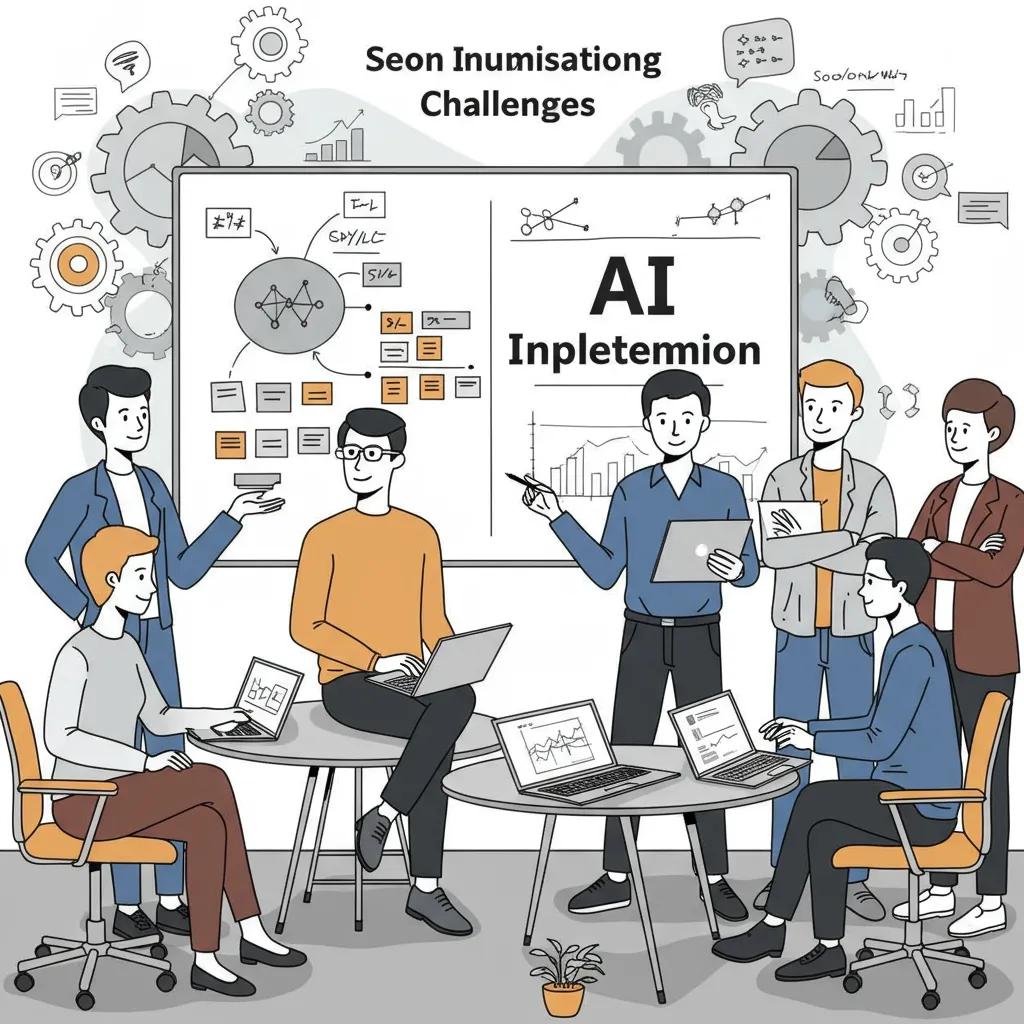
Common challenges include poor data quality, technical debt, talent gaps, and change resistance; each requires a specific mitigation strategy. Data quality needs automated cleaning pipelines and clear ownership, while technical debt is managed through modular architecture and containerized deployments. Talent gaps can be addressed with vendor partnerships, training programs, and embedding citizen developer workflows. Change resistance is reduced by involving business stakeholders early and demonstrating tangible pilot wins.
How do businesses measure ROI and success from AI investments?
Measuring AI ROI requires baseline KPIs, control groups, and attribution methods such as A/B testing and pilot baselines to isolate impact. Primary metrics include cost savings, time-to-insight, revenue uplift, and error reduction, while secondary metrics track adoption and model performance. Create dashboards that combine business KPIs with model health indicators like accuracy and drift to maintain end-to-end visibility. Regularly review and recalibrate metrics as systems scale to ensure sustained value.
Intro to implementation-phase EAV table
Many organizations engage external consulting or implementation services to accelerate pilots, integrate systems, and set up governance. Typical services include data engineering to build pipelines, model development and tuning, deployment automation, and governance framework design. Vendors often provide training, knowledge transfer, and managed services for monitoring and model retraining. Evaluating such services against internal capacity and desired time-to-value helps decide whether to build, buy, or partner.
What Emerging AI Trends Will Shape Business Transformation Beyond 2026?
Which new AI technologies are businesses adopting?
Businesses are adopting generative agents for autonomous workflows, multimodal models that combine text, image, and audio, and specialized LLMs fine-tuned for industry domains. On-device AI enables low-latency personalization and data privacy by keeping inference local, while model distillation reduces costs for production deployment. Pilot experiments should focus on clearly defined success metrics and safe failure modes to limit operational risk.
The evolution of generative AI is significantly impacting digital content marketing by enabling new approaches to content creation and campaign management.
Generative AI’s Role in Digital Content Marketing Evolution
Several marketing activities have benefitted from the adoption of generative artificial intelligence (GAI) tools and thus, shifted how digital content marketing (DCM) activities are approached by experts. The purpose of this study is to explore what kind of roles humans and GAI tools such as ChatGPT and Microsoft Copilot have in DCM. This study deployed qualitative research methods and conducted semi-structured interviews with eight professionals from various levels of seniority working with DCM to determine how they view the role of GAI.
Exploring the role of generative artificial intelligence in digital content marketing, 2024
How will AI ethics and responsible use influence business AI adoption?
AI ethics influences adoption through requirements for transparency, fairness, privacy, and accountability, pushing organizations to implement explainability, bias testing, and robust data governance. Responsible AI practices include documentation of model provenance, input-output testing, and human oversight for high-risk decisions. Regulatory trends will increasingly require demonstrable compliance, so embedding governance early reduces rework and ensures sustainable adoption.
What industries will see the biggest AI impact in coming years?
High-impact industries include finance, healthcare, retail, manufacturing, and logistics due to their abundant structured data, clear KPIs, and cost-saving potential. Finance benefits from fraud detection and algorithmic forecasting; healthcare gains from diagnostic CV tools and predictive patient management; retail uses personalization and inventory forecasting; manufacturing leverages CV and predictive maintenance; logistics applies route optimization and demand forecasting. Industry pilots should focus on measurable operational metrics and regulatory constraints.
The application of generative AI in retail marketing is showing promise for automating campaign creation and enhancing engagement.
Generative AI for Automated Retail Marketing Campaigns
This paper proposes a new kind of Generative AI solution that would help with content creation for marketing practices. The AI model can create marketing content more appealing to target audiences, thereby improving campaign effectiveness and engagement.
Generative AI for retail marketing: Automated campaign creation and optimization, 2024
How Can Small and Medium Businesses Leverage AI Solutions Effectively in 2026?
What affordable AI tools are best suited for small businesses?
Affordable tool categories include chatbot SaaS platforms, analytics-as-a-service, no-code automation tools, and prebuilt recommendation engines that integrate with common e-commerce and CRM systems. Selection criteria should emphasize ease of integration, transparent pricing, and trialability to validate ROI before committing. Trials and pilot use reduce risk and provide the data needed to justify broader adoption.
How does AI help SMBs compete with larger enterprises?
AI enables SMBs to compete on personalization, automation, and faster decision cycles by automating routine tasks, delivering tailored customer experiences, and surfacing insights quickly. These capabilities compress time-to-market and allow nimble businesses to iterate on offers and operations with lower overhead. Demonstrated quick wins such as chatbots for support and recommendation widgets for higher conversion provide tangible competitive advantages.
What are practical steps for SMBs to start AI transformation?
SMBs can follow this quick-start five-step plan to begin AI transformation with minimal risk and clear timelines:
- Identify one high-impact use case with measurable KPIs.
- Perform a brief data check to confirm availability and quality.
- Choose an MVP tool or SaaS trial to implement quickly.
- Run a 6–8 week pilot with clear success criteria and control groups.
- Measure results and scale successful pilots incrementally.
These steps fit typical SMB resource constraints while providing a path to measurable ROI and scalable adoption. For organizations that want external support, evaluating consulting support for data pipelines and governance is a logical next step. Assessing business readiness through an internal checklist or assessment tool helps determine whether to engage partners or expand internal capabilities.
Frequently Asked Questions
What are the key considerations for implementing AI solutions in a business?
When implementing AI solutions, businesses should consider data readiness, integration capabilities, and the specific use cases that align with their strategic goals. It’s essential to assess the quality and availability of data, as well as the existing infrastructure for seamless integration. Additionally, organizations should prioritize use cases based on potential ROI and feasibility. Establishing a governance framework to monitor performance and ensure compliance with ethical standards is also crucial for successful implementation.
How can businesses ensure ethical AI usage?
To ensure ethical AI usage, businesses should implement practices that promote transparency, fairness, and accountability. This includes conducting bias testing, maintaining clear documentation of model development processes, and ensuring human oversight in decision-making. Organizations should also establish guidelines for data privacy and security, and regularly review their AI systems for compliance with ethical standards and regulations. Engaging stakeholders in discussions about ethical implications can further enhance responsible AI practices.
What role does employee training play in AI adoption?
Employee training is vital for successful AI adoption as it equips staff with the necessary skills to leverage AI tools effectively. Training programs should focus on understanding AI technologies, data literacy, and how to interpret AI-generated insights. By fostering a culture of continuous learning, organizations can enhance employee engagement and reduce resistance to change. Additionally, training can help employees identify opportunities for AI integration in their workflows, maximizing the benefits of AI solutions.
How can small businesses measure the success of AI initiatives?
Small businesses can measure the success of AI initiatives by establishing clear KPIs that align with their strategic objectives. Common metrics include cost savings, time efficiency, customer satisfaction scores, and revenue growth. Implementing A/B testing and pilot programs can provide valuable insights into the effectiveness of AI solutions. Regularly reviewing these metrics and adjusting strategies based on performance data will help small businesses optimize their AI investments and demonstrate ROI.
What are the potential risks associated with AI implementation?
Potential risks associated with AI implementation include data privacy concerns, algorithmic bias, and the possibility of over-reliance on automated systems. Poor data quality can lead to inaccurate predictions, while biased algorithms may perpetuate existing inequalities. Additionally, organizations may face challenges in managing change and ensuring employee buy-in. To mitigate these risks, businesses should prioritize ethical AI practices, conduct thorough testing, and maintain human oversight in critical decision-making processes.
How can businesses stay updated on emerging AI trends?
Businesses can stay updated on emerging AI trends by engaging with industry publications, attending conferences, and participating in webinars focused on AI advancements. Networking with AI professionals and joining relevant online communities can also provide insights into best practices and innovative applications. Additionally, subscribing to newsletters from AI research organizations and following thought leaders on social media can help organizations remain informed about the latest developments and technologies in the AI landscape.
Conclusion
Embracing AI solutions in 2026 can significantly enhance business efficiency, customer engagement, and decision-making capabilities. By leveraging tools like predictive analytics, conversational AI, and automation, organizations can achieve measurable improvements in performance and ROI. Understanding the strategic implementation of these technologies is crucial for staying competitive in a rapidly evolving landscape. Start your journey towards AI transformation today by exploring our comprehensive resources and expert guidance.