

How to Use an AI Marketing Generator to Transform Your Campaigns with Effective AI Marketing Campaign Strategies
AI marketing generators are software systems that use generative AI and predictive analytics to create campaign assets, propose audience segments, and optimize delivery for measurable business outcomes. This guide teaches marketers how these tools work, what tangible benefits they deliver, and the step-by-step workflows for integrating AI into content creation, segmentation, and cross-channel optimization. Many teams struggle with scaling personalization and keeping creative fresh; an AI marketing generator automates repetitive production while surfacing high-impact variations that improve conversion and cut time-to-market. Below you will find clear definitions, types of generators, tactical prompt-and-edit workflows for text, image and video assets, segmentation and orchestration patterns, channel-specific optimization tips, plus KPI frameworks and ethical guidelines for responsible implementation. Throughout the article we use terms like marketing plan generator, AI marketing generator, generative AI for marketing, and AI marketing automation platforms to connect practical steps to strategic outcomes.
What Is an AI Marketing Generator and How Does It Work?
An AI marketing generator is a class of generative AI system that transforms inputs—briefs, data feeds, and performance signals—into marketing outputs like copy, creatives, audience lists, and optimization rules. It works by combining large language models and multimodal generative models with prediction/analytics components to score candidate outputs and suggest the best variants for A/B testing. The practical result is faster creative iteration and data-driven personalization at scale, enabling teams to test many micro-variations while retaining human oversight. Understanding these core mechanics helps you choose the right modality and design governance checkpoints before deploying campaign automation.
What Are the Different Types of AI Marketing Generators?
AI marketing generators come in modality-specific and function-specific forms that suit different campaign needs. Text-based AI marketing generators specialize in blog posts, ad copy, and email sequences by using prompt engineering to control tone and structure. Image-based generators produce social creatives, banners, and thumbnails with style and brand tokens as inputs, and video-based systems generate short social videos or animated demo clips from scripts and storyboards. These hyponyms—text-based, image-based, and video-based generators—fit under the hypernym generative AI and often include meronym modules like content generation, audience segmentation engines, and CRM/CMS connectors.
Common generator categories include:
- Text generators: Produce headlines, descriptions, emails, and long-form content.
- Image generators: Create ad banners, social posts, and visual assets from style prompts.
- Video generators: Assemble short clips, captions, and animated demos from scripts.
Each type maps to a different workflow; for example, text generators often require editorial review and SEO tuning, while image and video generators need brand-compliance checks and format optimization before publishing.
How Does AI Automate and Optimize Marketing Campaigns?
AI automation applies to repetitive tasks like drafting creative variants, scheduling, and bid management while optimization uses model-driven scoring to reallocate budget and choose winning variants in real time. Multi-armed bandit or Bayesian optimization approaches let the system shift traffic toward higher-performing ad variations, and predictive models estimate conversion probability for new segments. In practice this means an AI marketing generator can spin up dozens of subject-line variations, test them on small cohorts, and automatically scale the winners; human-in-the-loop checkpoints intervene for brand safety and legal compliance. That human oversight completes the loop: models generate and iterate, while teams validate quality and strategic alignment before full rollout.
What Are the Key Benefits of Using AI in Marketing Campaigns?
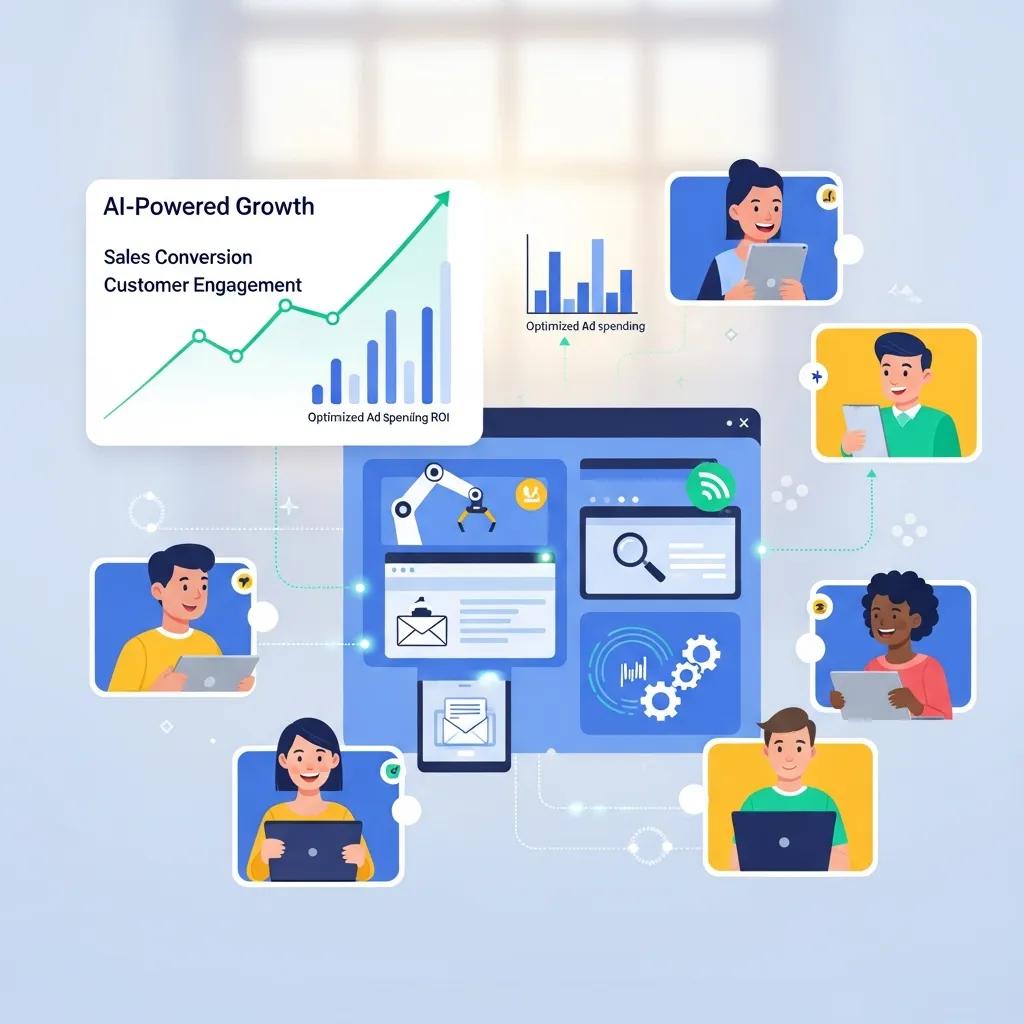
An AI marketing generator delivers efficiency, personalization, cost optimization, and scalability by automating content creation and decisioning while using data to target precisely. Mechanistically, these systems reduce manual production steps through templates and prompts, accelerate iteration with automated testing, and surface personalization rules from predictive analytics that increase conversion. The primary benefit is measurable uplift in campaign performance with lower marginal cost per creative variant, enabling teams to redirect effort from production to strategy and insight. The next paragraphs unpack efficiency metrics, personalization at scale, and cost impacts using a quick comparison table and practical examples.
Different AI capabilities translate to distinct value across efficiency, personalization, and scalability:
This table maps high-level benefits to concrete outcomes and shows how AI components—content generation modules and prediction engines—drive measurable improvements. The next section explores quantified efficiency gains and operational shifts that occur when teams adopt these tools.
How Does AI Improve Marketing Efficiency and Reduce Costs?
AI reduces repetitive labor by generating initial drafts, routing assets to reviewers, and automating routine optimization tasks, which decreases production bottlenecks and speeds campaign launches. For example, generating ad creative variants programmatically lets teams test more hypotheses with the same headcount, reallocating talent toward strategy and interpretation. Typical efficiency gains include faster content throughput and reduced revision cycles, while cost reductions stem from improved targeting, automated bidding, and fewer creative reshoots. Tracking time-saved metrics and conversion-per-hour helps justify investment and informs whether to scale automation further.
Examples of operational shifts:
- From manual copy production to prompt-driven drafts that editors refine.
- From fixed creative schedules to continuous variant testing powered by AI scoring.
- From manual bid adjustments to model-driven budget allocation that minimizes waste.
These changes compound: quicker iterations plus better targeting lower cost per acquisition and enable higher-frequency testing of creative hypotheses.
How Does AI Enable Hyper-Personalized Marketing Experiences?

AI enables hyper-personalization by combining behavioral, transactional, and contextual signals into dynamic content rules that adapt messaging to each customer. Models segment users into micro-cohorts and generate tailored email content, landing pages or ad creatives that reflect intent and lifecycle stage, producing noticeably higher engagement. Implementations often use dynamic tokens, modular templates, and on-the-fly creative assembly so each touchpoint feels individually relevant. Ensuring data quality and respecting privacy constraints is essential; clean signals and consented data allow models to personalize without crossing regulatory or ethical boundaries.
Personalization tactics include:
- Dynamic email content that swaps modules based on recent behavior.
- On-site personalization that rearranges components by predicted interest.
- Personalized ad creative that changes visual elements and copy per segment.
Adopting these techniques increases conversion probability and improves customer experience when orchestration and measurement are tightly integrated.
This research highlights how AI technologies are being integrated into business process management systems to create more adaptive and personalized customer interactions.
AI-Driven Optimization of the Customer Journey: Personalizing the User Experience
As customer expectations evolve rapidly in today’s digital landscape, organizations are re-evaluating strategies for delivering highly personalized user experiences across the entire customer journey. Business Process Management (BPM) systems, traditionally designed for operational efficiency, are undergoing a transformation driven by Artificial Intelligence (AI) to foster customer-centric innovation. This research examines how emerging AI technologies, including machine learning, conversational interfaces, sentiment analysis, and federated learning, enhance BPM systems to enable dynamic, context-aware, and adaptive interactions. Drawing upon recent scholarly work and industry case studies, we explore how intelligent automation facilitates real-time decision-making, predictive engagement, journey optimization, and process personalization.
AI-Powered Customer Journey Optimization: Personalizing User Experience in BPM Systems, DR Aunugu, 2025
How Can You Use AI for Content Creation in Marketing Campaigns?
Using generative AI for content creation involves designing prompts, selecting the right modality, and layering editorial and brand reviews to ensure quality and compliance. The core mechanism is prompt engineering: concise structured inputs that encode audience, tone, CTA, and format constraints so the model produces usable drafts. For images and video, storyboards and style tokens guide visual generation while export options and accessibility checks finalize assets. Below is a compact EAV-style table that shows how text, image, and video tools align with prompts and quality checks to inform practical workflows.
This table clarifies how different generative modules map to inputs and editorial controls. The next subsections provide hands-on templates for text prompts and visual/video workflows you can adopt immediately.
How to Generate Effective Text Content with AI Marketing Tools?
To generate effective marketing copy, craft prompts that specify audience, goal, tone, and length, then apply an editorial checklist that includes SEO, factual accuracy, and brand voice. A practical prompt template might state the target persona, primary benefit, desired CTAs, and a headline length constraint to produce high-quality variants. After generation, run content through an SEO pass—optimize title, headings, and metadata—and a fact-check pass to prevent misinformation. Finally, use human review to refine nuance and ensure compliance, creating a loop where model outputs inform subsequent prompt improvements.
Prompt templates to try:
- Ad headline + description: persona, benefit, CTA, character limits.
- Email sequence: audience segment, desired action, tone, and send cadence.
- Blog outline: target keyword, audience level, headings, and word count.
This approach combines prompt engineering with editorial governance so generated text meets both performance and brand standards.
How to Create Visual and Video Content Using Generative AI?
Generating visuals and video begins with a clear storyboard and style guide: define scenes, script beats, visual motifs, and accessibility requirements before feeding prompts to a model. For images, include brand tokens (logo placement, color schemes) and desired aspect ratios; for videos, provide scene timing, narration, and caption requirements. Iterate outputs with short cycles, capture variant IDs, and subject each candidate to brand-compliance and quality assurance checks, including legibility and mobile rendering. Export final assets in channel-appropriate formats and attach alt-text and transcripts for accessibility and discoverability.
Visual workflow checklist:
- Create storyboard with shot descriptions and duration.
- Generate variants with different visual styles and test performance.
- Validate brand safety, accessibility, and export formats before publishing.
Combining these steps ensures generated assets are both creative and production-ready across social, display, and landing page channels.
How Does AI Drive Personalized Marketing and Customer Segmentation?
AI drives segmentation by transforming raw data into predictive features and clusters that reflect behavior, propensity and lifetime value potential. Models—such as clustering algorithms and predictive scoring—identify micro-segments that manual rules often miss, enabling tailored journeys for lifecycle stage, product affinity or churn risk. The mechanism is straightforward: ingest behavioral, transactional and demographic signals, engineer features, and apply unsupervised or supervised algorithms to produce segments with actionable labels. Practical data hygiene, consent management, and feature documentation are necessary to keep segments reliable and compliant as input sources change.
How Does AI Analyze Customer Data for Segmentation?
AI analyzes customer data by converting interactions into structured features—purchase frequency, recency, product categories, session depth—and then using clustering (e.g., k-means variants) or predictive scores to group users by likely behavior. Data preprocessing and hygiene—de-duplication, normalization, and handling missing values—are essential to produce meaningful segments. A sample output might label segments as high-LTV frequent purchasers, recent browsers, or churn-risk cohorts, each with clear defining features that inform messaging. These segment definitions become inputs for dynamic content rules and campaign orchestration.
Key practices for segmentation:
- Feature engineering that captures intent and engagement signals.
- Model validation to confirm segments predict behaviors of interest.
- Privacy-first controls such as data minimization and consent checks.
Accurate segmentation enables precise targeting and personalization strategies that improve conversion rates and lifetime value.
What Are Best Practices for Delivering Personalized Customer Journeys?
Design personalized journeys by mapping triggers, channel paths, and desired outcomes, then orchestrate these flows using real-time event triggers and adaptive content modules. Best practices include keeping orchestration rules modular (so content can be swapped in), testing workflows via holdout groups before wide rollout, and instrumenting metrics at each touchpoint to iteratively optimize flows. Orchestration should respect privacy settings and provide transparent choices for customers. Continuous experimentation—A/B tests and multi-variant tests—keeps journeys fresh and aligned with evolving user behavior.
Recommended orchestration checklist:
- Define triggers and outcomes for each journey stage.
- Use modular content blocks to enable dynamic swaps.
- Measure and iterate using controlled experiments and holdouts.
These practices help teams scale personalization without losing control over brand experience or compliance.
How Can AI Optimize Campaign Performance Across Channels?
AI enhances channel performance by tailoring optimizations to the specific mechanics of SEO, social, email, and paid channels using dedicated models and automation connectors. For SEO, AI assists with keyword discovery, content gap analysis, and on-page optimization recommendations; for social and paid channels, AI generates creative variants, predicts audience response, and suggests pacing and budget shifts. Cross-channel orchestration uses predictive attribution models to route budget to the highest-contributing channels while ensuring consistent messaging. Below, channel-specific tactics and an actionable checklist show how to incorporate AI into existing stacks.
How Does AI Enhance SEO and Content Optimization?
AI enhances SEO by automating keyword research, clustering topics into content pillars, and scoring drafts for topical relevance and readability using content-scoring models. The mechanism is to surface semantic keywords, recommend structural changes to headings and metadata, and suggest internal linking opportunities that improve discoverability. A stepwise checklist helps integrate AI: analyze keyword opportunities, generate an optimized outline, produce drafts with SEO prompts, and run content scoring before publishing. Monitoring and iterating based on organic performance metrics closes the loop and refines future content briefs.
SEO optimization checklist:
- Automated keyword and topic clustering to find gaps.
- AI-assisted draft generation that includes suggested headings and metadata.
- Content scoring and iterative refinement based on performance signals.
Using AI for SEO reduces research time and generates more targeted content that ranks and converts.
How Is AI Used in Social Media and Email Marketing Campaigns?
In social and email, AI generates creative variants, optimizes targeting, and personalizes send times and subject lines for higher engagement. Practical tactics include using AI to produce multiple ad creatives per audience persona, employing lookalike generation from high-value segments, and testing subject-line variants programmatically to discover winners. Channel KPIs—like CTR for social and open-rate plus conversion rate for email—guide automated optimization rules that shift creative and budget toward top performers. Set up A/B or multi-armed bandit tests with clear success metrics and roll winners out automatically under human review.
Tactical steps for channel optimization:
- Generate multiple creative variants for persona-specific testing.
- Run automated subject-line and send-time optimization for email.
- Use predictive lookalike audiences to expand reach efficiently.
These steps let teams systematically improve channel outcomes while maintaining editorial control.
A comprehensive review of AI applications in retail marketing analytics reveals a broad spectrum of techniques that significantly enhance campaign forecasting, adaptability, and customer segmentation.
AI-Powered Marketing Analytics for Retail Strategy: A Review of Campaign Optimization
Artificial intelligence (AI) has become a transformative technology in retail marketing, fundamentally altering how organizations design, implement, and optimize campaign strategies. This umbrella review synthesizes findings from 72 peer-reviewed systematic reviews and meta-analyses published between 2010 and 2024, offering a comprehensive, macro-level assessment of AI applications in marketing analytics for enhancing retail performance. The reviewed literature covers a broad spectrum of AI techniques, including supervised learning, unsupervised learning, deep learning, reinforcement learning, and natural language processing (NLP), and their respective contributions to improving campaign forecasting, real-time adaptability, customer segmentation, personalization, sentiment analysis, and attribution modeling.
AI-driven marketing analytics for retail strategy: a systematic review of data-backed campaign optimization, TA Rainy, 2025
How Do You Measure ROI and Address Ethical Concerns When Using AI Marketing Generators?
Measuring ROI for AI interventions means attributing incremental impact to model-driven changes through experimental design and specific KPI tracking. Core metrics include CPA, CTR lift, conversion rate improvement, and time saved, and calculating ROI involves comparing incremental revenue or cost savings against incremental cost of AI tools and implementation. Ethically, teams must adopt governance practices—bias testing, data minimization, transparency, and human-in-the-loop review—to ensure outputs are fair and compliant. The following table summarizes key metrics and how to calculate or benchmark them for quick reference.
This table helps teams set baselines and monitor the direct impact of AI-powered changes. The next subsections translate these metrics into measurement plans and practical governance checklists.
What Metrics Should You Track to Measure AI Marketing Success?
Track primary KPIs—CPA, conversion rate, and incremental revenue—alongside secondary KPIs such as CTR lift, engagement, and time saved in production. Establish baselines through historical averages, then use randomized holdout or A/B tests to isolate model impact; for example, route a randomized subset of traffic to AI-generated creatives while maintaining a control group. Calculate ROI as incremental revenue attributable to the AI intervention divided by incremental costs (including tool subscriptions and human review time). Report metrics on a defined cadence—weekly for tactical signals and monthly for strategic ROI—so teams can course-correct quickly.
Measurement best practices:
- Use randomized control groups or holdouts to attribute impact.
- Track both performance and operational metrics (e.g., time saved).
- Set reporting cadence that balances rapid iteration and strategic oversight.
These practices ensure your AI investments are tied to measurable business outcomes rather than nebulous productivity gains.
How Can Marketers Ensure Ethical and Responsible AI Use?
Responsible AI use requires a governance checklist that includes transparency, bias testing, data minimization, human review, and documentation of model decisions. Implement pre-deployment checks for dataset representativeness, run bias-detection tests on outputs, and maintain an audit trail of prompt versions and model parameters. Enforce data protection practices—limit data retention and honor consent—while keeping humans in the loop for final approvals, especially for high-impact messages. A practical bias-check procedure involves sampling outputs across demographic slices, scoring for disparate impact, and remediating prompt or data imbalances before scaling.
Ethical governance checklist:
- Bias detection and mitigation using representative tests.
- Privacy controls: consent management and data minimization.
- Human oversight and documentation for auditability.
Adopting this governance framework helps you scale AI-driven marketing while protecting customers and brand integrity.