

AI-Driven Marketing Services to Accelerate Digital Growth
Artificial intelligence marketing agencies combine data, models, and creative workflows to drive measurable digital growth across channels. This article explains what an AI marketing agency is, how machine learning and generative models transform SEO, paid media, content, email, and analytics, and which outcomes businesses can expect when they adopt AI-enabled marketing services. Readers will learn the core technologies that power modern agencies, a practical catalog of AI-enabled services, industry-specific playbooks for e-commerce and B2B, and a vendor-evaluation checklist to choose the right partner. Pain points such as slow experimentation, fragmented personalization, and manual campaign optimization are addressed with step-by-step mechanisms and implementation guidance. The piece also summarizes 2025 trends—generative AI, predictive analytics, privacy-preserving models—and ends with concise Q&A for rapid clarity. Throughout, keywords like ai marketing agency, AI for SEO, AI content creation, and predictive analytics marketing are integrated to support discoverability and practical decision-making.
What Is an AI Marketing Agency and How Does It Transform Digital Marketing?
An AI marketing agency is a specialized marketing services provider that uses machine learning, natural language processing, and generative models to automate tasks, personalize experiences, and predict outcomes for digital channels. By ingesting first- and third-party data, training prediction models, and integrating automation, these agencies turn raw signals into optimized creative and media decisions that improve ROAS and reduce operational cost. The transformation occurs through four linked mechanisms: data consolidation, model-driven optimization, automated execution, and continuous learning loops that update strategies in real time. This structural change reduces manual campaign overhead while increasing precision in audience targeting and creative relevance, which in turn raises conversion rates and customer lifetime value. Next we examine the concrete ways AI augments agency services and the technologies that make it possible.
How Does Artificial Intelligence Enhance Marketing Agency Services?
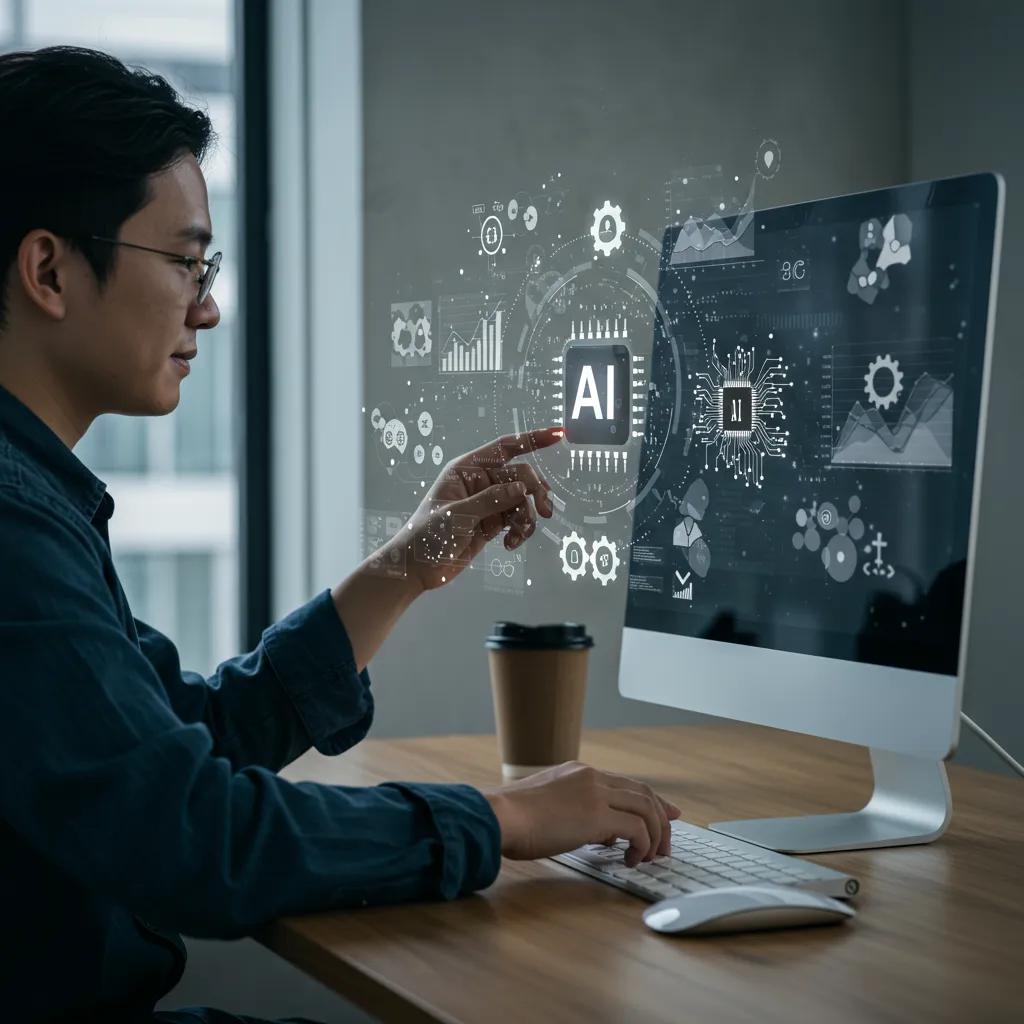
Artificial intelligence enhances agency services by automating repetitive tasks, surfacing predictive insights, and augmenting creative workflows through model-driven suggestions and generation. Automation handles bidding, reporting, and routine segmentation, freeing teams to focus on strategy while ensuring consistent execution at scale. Predictive analytics identify high-propensity audiences and forecast campaign outcomes, enabling better budget allocation and faster experiment cycles. Creative augmentation uses generative AI to produce drafts for copy, images, and video variants that are then validated through A/B testing and editorial controls. These capabilities translate into measurable improvements in speed, efficiency, and campaign performance while maintaining human oversight for quality and brand safety.
What Core AI Technologies Power Modern Marketing Agencies?
Core AI technologies powering modern marketing agencies include supervised machine learning for prediction, natural language processing for content and conversational interfaces, computer vision for creative and ad quality, generative models for scaled content creation, and predictive analytics engines for forecasting. Supervised models optimize bids and predict conversion probability from user signals, while NLP powers subject-line optimization, automated content briefs, and chatbots. Computer vision automates creative scoring and ad variant selection, and generative models accelerate ideation and draft production for multi-format campaigns. Predictive analytics models forecast customer lifetime value and churn risk, informing segmentation and budgeting decisions that improve long-term marketing ROI.
How Do AI Marketing Agencies Improve Customer Experience and Personalization?
AI marketing agencies improve customer experience through precise segmentation, real-time recommendations, and dynamic creative that adapts to user signals across touchpoints. Data pipelines collect behavior, transaction, and CRM attributes to feed recommendation engines that personalize content, product suggestions, and email sequences at scale. Dynamic creative optimization stitches different headlines, images, and offers into tailored variants that align with user intent, increasing relevance and engagement. Key KPIs to track include conversion uplift, average order value, click-through rates, and retention—metrics that collectively demonstrate how personalization improves both short-term conversions and long-term customer lifetime value.
Which AI Marketing Services Do Top Digital Marketing Agencies Offer?
Top digital marketing agencies now offer a catalog of AI-enabled services that map directly to traditional marketing functions, turning manual workflows into data-driven systems for measurable impact. These services include AI SEO optimization, AI PPC management, AI content creation, AI-powered email marketing, conversational AI for CX and qualification, and predictive analytics for strategic planning. Each service pairs a specific technology stack with outcome-oriented KPIs such as CTR uplift, reduced cost-per-acquisition, or time saved on content production. Below is a compact comparison of the main services, the primary AI techniques they use, and the key benefits clients typically observe.
Different AI services use focused techniques and deliver measurable outcomes across channels.
This table helps buyers compare services by technology and outcome, making procurement conversations more evidence-based.
How Does AI Optimize SEO and PPC Campaigns?
AI optimizes SEO and PPC by combining intent modeling, automated content recommendations, and predictive bidding to align spend and creative with user intent. For SEO, NLP-driven topic modeling and on-page optimization tools surface gaps and prioritize high-impact pages for update, while entity-aware approaches improve semantic relevance for AI search. For paid search and display, predictive bidding models estimate conversion likelihood and dynamically allocate budget to channels and audiences with the highest expected return. Typical workflows involve data ingestion, model training, real-time scoring, and automated bid adjustments, with KPIs monitored via dashboards to validate incremental ROAS and reduced CPA.
What Are the Benefits of AI-Powered Content Creation and Copywriting?
AI-powered content creation speeds ideation, drafts, and scaling while preserving editorial control through human-in-the-loop workflows. Generative models produce keyword-led outlines, first drafts, and creative variants that editors refine for tone, accuracy, and compliance. This process reduces time-to-publish, enables rapid multivariate testing of headlines and CTAs, and supports SEO optimization at scale. Quality controls—fact-checking layers, style guides, and plagiarism detection—ensure outputs align with brand and regulatory requirements while improving content ROI through increased organic traffic and lower production costs.
Generative AI Revolutionizes Digital Content Creation, Curation, and Automation in Marketing
Fast-developing Generative AI technology, such as ChatGPT and DALL-E, has quietly turned digital content creation, curation, and automation upside down. These breakthrough solutions “automate” the very process of creating content, delivering creativity at scale and massively scaling the production of personalized content. This paper examines the impact of Generative AI in revolutionizing digital workflows (from content generation to curation) spanning across various domains, e.g., marketing, entertainment and education. Applications such as ChatGPT facilitate creation of text content, whereas other tools such as DALL-E boost the creation of visual content via image generation from text descriptions. Through case studies, the paper discusses human oversight vs AI efficiency, and the challenge of maintaining control over quality while also using fast, scalable AI. It also examines the role of AI in content personalization, offering a behind-the-scenes look at how AI-driven
Generative AI in Digital Content Creation, Curation and Automation, 2023
How Is AI Used for Email Marketing and Conversational AI?
AI enhances email marketing with segmentation, subject-line optimization, and send-time personalization, while conversational AI supports lead qualification and immediate customer support. Personalization engines score users by conversion propensity and trigger tailored sequences that evolve based on engagement signals. Subject-line and cadence experiments use model-driven suggestions to lift open and click rates, and send-time models determine optimal delivery windows for each recipient. Conversational AI chatbots handle initial qualification, route high-value leads to sales, and resolve routine support requests, shortening response times and improving lead-to-opportunity conversion.
How Do AI Marketing Agencies Use Data Analytics for Performance Optimization?
AI-driven analytics consolidate cross-channel data into model-backed insights for attribution, anomaly detection, and continuous optimization. Agencies implement attribution models that combine last-click, data-driven, and econometric approaches to surface true incremental impact and inform budget shifts. Automated anomaly detection flags performance deviations in real time, enabling rapid remediation of creative or bidding issues. Continuous experimentation loops—test, learn, deploy—are supported by dashboards that track predictive KPIs like forecasted ROAS and churn risk, allowing stakeholders to make proactive, data-backed decisions.
AI and Predictive Analytics Drive Digital Marketing Strategy and ROI Growth
The study explores the effects of artificial intelligence (AI) and predictive analytics on digital marketing strategy and return on investment (ROI). It reviews relevant literature on the use of AI and predictive analytics in digital marketing, focusing on email marketing, customization, social media marketing optimization, and consumer segmentation. The research methodology is described, including data collection and analysis procedures. The findings highlight the significant impact of predictive analytics and AI on digital marketing strategy and ROI, with businesses that effectively utilize these technologies reporting higher engagement, conversions, and revenue growth. The study acknowledges limitations and proposes future research directions of successful AI and predictive analytics integration in digital marketing campaigns. It concludes with recommendations for businesses to invest in predictive analytics and AI to remain competitive in the dynamic digital landscape.
The impact of predictive analytics and AI on digital marketing strategy and ROI, MA Al Khaldy, 2023
What Are the Key Benefits of Partnering with an AI-Driven Marketing Agency?
Partnering with an AI-driven marketing agency delivers measurable business outcomes through efficiency gains, scalability of personalization, and faster insight cycles that lead to higher ROI. These agencies reduce manual workload with automation, increase the volume and relevance of customer touchpoints with dynamic creative, and surface predictive signals that improve budget allocation. The net result is improved conversion rates, lowered acquisition costs, and the ability to sustain personalized experiences at scale without proportional headcount increases. Below is a table mapping core benefits to expected metric impacts and example outcomes to make procurement conversations more concrete.
This mapping shows how specific AI capabilities translate into measurable improvements, helping buyers set realistic goals and KPIs for pilot projects.
How Does AI Increase Marketing ROI and Campaign Efficiency?
AI increases marketing ROI by optimizing budget allocation, automating bidding, and accelerating experimentation cycles that reveal high-performing strategies faster. Predictive models estimate incremental value per audience segment, enabling teams to reallocate spend to the most profitable cohorts and reduce wasted impressions. Automation reduces setup and reporting time, allowing more frequent and granular experiments that compound into better creative and targeting. Measuring ROI typically involves baseline performance, A/B or holdout tests, and attribution adjustments to isolate AI-driven uplift in conversion rates and lifetime value.
In What Ways Does AI Enable Hyper-Personalization at Scale?
AI enables hyper-personalization by linking identity graphs and behavioral signals to dynamic creative systems that assemble individualized experiences across web, email, and ads. The architecture follows a pipeline: data collection → feature engineering → real-time scoring → dynamic creative assembly. Recommendation engines generate product or content suggestions based on similarity and propensity models, while dynamic ad templates insert personalized imagery and messaging for each user. The impact shows up in higher click-through rates, increased average order value, and improved retention as recipients receive content that better matches their intent and stage in the journey.
How Does AI Help Marketing Agencies Stay Competitive in 2025 and Beyond?
AI helps agencies stay competitive by shortening the feedback loop between creative experiments and measurable outcomes, adopting generative workflows to increase output velocity, and leveraging predictive analytics to anticipate market changes. Agencies that embed continuous learning models can adapt campaigns as consumer behavior shifts, maintaining relevance and efficiency. Embracing privacy-preserving techniques and governance frameworks also differentiates providers, particularly for brands in regulated industries. Agencies that integrate these capabilities into standard operating procedures will sustain lower acquisition costs and faster time-to-insight than traditional providers.
How Do AI Marketing Agencies Implement AI Solutions Across Industries?
AI marketing agencies implement solutions differently by industry, tailoring data sources, compliance measures, and customer journey mapping to vertical needs. For retail and e-commerce, emphasis is on recommendations, dynamic pricing, and retail media optimization; for B2B SaaS and pharma, the focus shifts to intent modeling, account-based personalization, and compliance-aware content. Implementation follows a phased playbook—discovery, data pipeline build, model development, pilot deployment, and scale—adjusted for regulatory and procurement constraints per sector. Next we outline tactical strategies for key verticals and emerging applications shaping industry-specific marketing.
What AI Marketing Strategies Work Best for E-commerce and Retail?

E-commerce strategies prioritize product recommendations, personalized merchandising, dynamic creative optimization, and retail media management to improve conversion rates and average order value. Recommendation systems use collaborative filtering and propensity modeling to surface relevant products, while dynamic creative tailors banners and email content based on browsing and purchase history. Retail media optimization applies predictive bidding to vendor and category opportunities within marketplace channels and measures incremental sales lift. KPIs include conversion rate, average order value, repeat purchase rate, and ROAS for retail campaigns.
AI Enhances E-commerce Competitiveness via SEO and Digital Marketing Strategies
This study systematically investigates how artificial intelligence (AI) enhances market competitiveness through its application in search engine optimization (SEO) and digital marketing strategies within e-commerce environments. In an increasingly saturated and algorithm-driven digital marketplace, firms are under continuous pressure to improve visibility, personalization, and customer engagement. The research followed the Preferred Reporting Items for Systematic Reviews and Meta-Analyses (PRISMA) guidelines to ensure a transparent and rigorous review process. A total of 112 peer-reviewed articles, published between 2012 and 2025, were selected and analyzed across five major academic databases and relevant grey literature. The findings reveal that AI technologies—such as machine learning, natural language processing, robotic process automation, and predictive analytics—are instrumental in transforming traditional marketing workflows across the entire digital funnel. AI-p
Enhancing Market Competitiveness Through AI-Powered SEO And Digital Marketing Strategies In E-Commerce, R Hasan, 2025
How Is AI Applied in B2B SaaS and Pharma Marketing?
In B2B SaaS and pharma, AI is applied to account-based predictive scoring, intent detection, compliance-aware content personalization, and long-cycle attribution modeling that respects regulatory constraints. Lead scoring models prioritize accounts with the highest conversion likelihood, enabling targeted outreach and content sequencing for complex buying cycles. Pharma content requires additional validation layers and governance workflows to ensure claims comply with regulations, while attribution models must account for multi-touch, long-horizon conversions. These adaptations ensure AI delivers value without compromising legal or ethical standards.
What Emerging AI Applications Are Shaping Industry-Specific Marketing?
Emerging applications include voice-search optimization, synthetic audience simulation, AR/VR creative generation, and privacy-preserving learning methods such as federated learning and differential privacy. Voice and conversational search optimization align content to spoken intent and short-form queries used by assistants, improving discovery in voice-first contexts. Synthetic audience modeling simulates user cohorts for scenario testing and creative stress tests, while AR/VR generation opens new immersive ad formats. Privacy-preserving models enable learning from distributed data without exposing raw personal information, increasing adoption in regulated industries.
What Are the Latest AI Marketing Trends and Tools for 2025?
The latest trends for 2025 include widespread adoption of generative AI for creative and campaign ideation, integrated predictive analytics for budget planning, and governance frameworks for safe model deployment. Platforms are consolidating capabilities—content generation, analytics, and ad optimization—into unified stacks that emphasize integration and data lineage. Selection criteria for tools focus on scalability, API integrations, governance features, and explainability to ensure outputs are auditable. Below we summarize tool categories and selection considerations to guide procurement decisions in the current market environment.
Which Are the Best AI Marketing Platforms and Tools Available Today?
Best-fit platforms fall into categories: content generation, ad optimization, analytics/forecasting, and conversational AI, each with distinct capabilities and integration needs. Content platforms streamline prompt workflows, version control, and editorial governance. Ad optimization tools provide predictive bidding and creative testing pipelines. Analytics platforms offer unified customer views, attribution, and forecasting models. When evaluating tools, prioritize data connectors, model explainability, security controls, and the ability to support human-in-the-loop processes for quality assurance and compliance.
How Is Generative AI Revolutionizing Content and Campaign Creation?
Generative AI revolutionizes content by enabling fast ideation, multi-format drafts, and scalable personalization, but it requires robust editorial guardrails to prevent hallucinations and brand drift. Practical workflows embed quality checks: fact verification, style enforcement, and legal review before publication. Human-in-the-loop stages ensure sensitivity to regulatory constraints and brand tone. When combined with experimentation frameworks, generative outputs accelerate testing of headlines, creatives, and offers while preserving accountability and traceability for each piece of content.
What Role Does Predictive Analytics Play in Future Marketing Strategies?
Predictive analytics provides forecasts for demand, customer lifetime value, churn risk, and campaign outcomes that directly inform media budgets and creative prioritization. Models translate historical behavior into propensity scores used for audience selection and bid strategies, while scenario analysis supports strategic planning under different market assumptions. Integrating predictive outputs with experimentation enables closed-loop learning where models update from test results, improving forecasting accuracy over time and helping marketers allocate resources to maximize long-term value.
How Can Businesses Choose the Right AI Marketing Agency for Their Needs?
Choosing the right AI marketing agency requires a structured evaluation across technology maturity, data governance, evidence of ROI, and team expertise. A clear procurement checklist helps buyers validate provider claims, surface red flags, and compare alternatives on objective criteria. The table below offers an evaluation matrix with criteria, what to check, and red flags or positive indicators to make vendor selection faster and more rigorous.
This matrix helps teams ask for concrete evidence rather than marketing claims, making it easier to audit an agency’s AI capabilities.
What Criteria Should You Use to Evaluate AI Marketing Agencies?
Evaluate agencies on technology integrations, data governance, methodological transparency, team expertise, and demonstrable ROI through case studies and pilots. Confirm they can connect to your data sources, explain model decisions, and provide SLAs for performance and security. Check for privacy-preserving practices and compliance readiness if you operate in regulated industries. Prioritize agencies that propose measurable pilots with clear baselines and success metrics to validate performance before committing to larger engagements.
How Do Case Studies Demonstrate AI Marketing Success and ROI?
Strong case studies present a clear baseline, methodology, measurable uplift, and time horizon, showing how models were trained, validated, and deployed. Look for documented KPIs such as percentage increase in conversion rate, reduction in CPA, uplift in average order value, and retention improvements over specified periods. Transparent methodology and third-party validation or holdout tests increase credibility. A useful case study also discloses limitations and what changes were required to operationalize the solution for scale.
What Questions Should You Ask Before Hiring an AI Marketing Partner?
- How will you access and process our data, and who owns the resulting models and outputs?
- Can you show documented model performance and examples of holdout tests?
- What governance and privacy controls do you implement for regulated data?
- How do you prevent and detect hallucinations or biased outputs from generative models?
- What are your SLAs for uptime, reporting cadence, and remediation?
- How will you measure incremental lift and attribution for our campaigns?
- What costs and pricing structures apply to pilots and scaling?
- How do you handle handover and knowledge transfer to internal teams?
What Are Common Questions About AI Marketing Agencies?
This final section answers frequent short-form questions to provide quick clarity on definitions, mechanisms, and practical implications of partnering with AI-enabled marketing providers. Each Q&A below is designed for rapid consumption and to support featured snippet-style discovery.
What Is an AI Marketing Agency?
An AI marketing agency is a service provider that uses data-driven models, automation, and generative tools to plan, execute, and optimize marketing across channels. It combines machine learning, NLP, and analytics to improve targeting, creative relevance, and campaign efficiency. Services typically include AI SEO, predictive bidding, content generation, email personalization, and conversational AI. The goal is to convert data into repeatable processes that increase ROI and scale personalization without linear increases in team size.
How Does AI Help in Marketing?
AI helps by automating repetitive tasks, predicting customer behavior, personalizing communications at scale, and generating creative variants for faster testing. Automation accelerates deployment, predictive models improve budget allocation, personalization engines increase relevance, and generative tools speed content production. Together, these capabilities reduce cost-per-action, improve conversion rates, and enable more frequent experimentation to refine strategies. Monitoring and governance ensure these systems remain aligned with business goals and compliance requirements.
What Are the Benefits of AI in Digital Marketing?
AI delivers efficiency gains, better targeting, scaled personalization, and faster insights that translate to improved ROI and customer retention. It streamlines operations, increases the velocity of creative testing, and surfaces predictive signals for smarter budget allocation. Typical impacts include lower acquisition costs, higher conversion rates, and measurable increases in customer lifetime value when models are well-designed and governance is in place. These benefits make AI a strategic lever for competitive differentiation.
Which AI Tools Are Best for Marketing?
Tool selection should focus on categories—content generation, ad optimization, analytics, and conversational AI—with emphasis on integrations, explainability, and governance features. The “best” tool depends on use case: content-heavy programs need strong editorial controls; media-heavy programs require predictive bidding and creative testing pipelines; enterprise deployments prioritize data lineage and privacy features. Choose vendors that support human-in-the-loop workflows and provide transparent model performance metrics.
How Do AI Marketing Agencies Work?
AI marketing agencies follow a repeatable process: discovery and data audit, model development and validation, pilot deployment with controlled experiments, and scale with continuous optimization. Discovery identifies objectives, data sources, and constraints; model development creates and tests predictive or generative systems; pilots demonstrate incremental lift with A/B or holdout methodologies; scaling integrates models into production workflows and dashboards. Continuous monitoring and governance maintain performance and compliance over time, completing the lifecycle of an AI-enabled marketing program.