

How AI Will Reshape Your 2026 Marketing Playbook: A Practical System for Growth — and for Exit
Entering 2026, AI is no longer a nice-to-have — it’s a core capability for companies that want to scale, increase valuation, and set up a clean exit. This piece shows how AI-driven marketing systems upgrade customer acquisition, sharpen engagement, and make your business more attractive to buyers. With the right tools and processes, teams can boost efficiency, lift ROI, and build repeatable marketing engines that survive leadership changes.
We’ll walk through the essential components of AI in marketing, the concrete benefits for scalable customer acquisition, and the levers that maximize company valuation. Along the way you’ll see how Whiskey River Media blends AI and human strategy to build intelligent, transferable marketing systems.
Why Is AI Essential for Marketing Success in 2026?
AI matters because it turns large, noisy datasets into clear, actionable decisions. By automating routine work and surfacing predictive signals, AI frees teams to focus on strategy while continuously improving campaign performance. Recent figures show more than 80% of marketers have adopted AI tools — a clear signal that the market expects these capabilities.
Beyond efficiency gains, AI delivers measurable financial upside: organizations using AI-driven marketing often report ROI lifts around 30%. That kind of improvement changes acquisition economics, shortens payback windows, and strengthens your positioning with investors or buyers.
How Does AI Improve Marketing ROI Beyond Buzzwords?
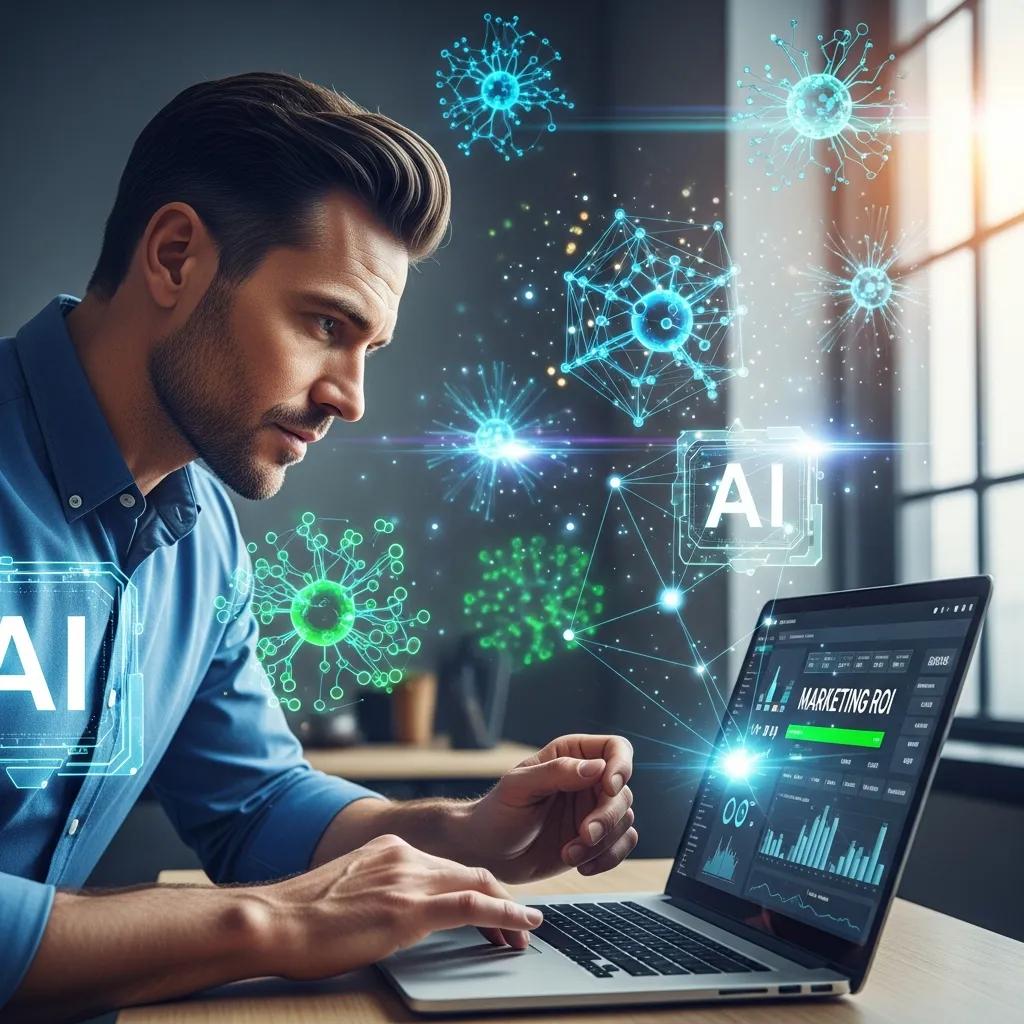
The ROI boost comes from smarter targeting and personalization. AI segments customers by behavior and intent, so messages reach the right people at the right time — that raises conversion rates and lowers acquisition cost.
AI also delivers near real-time performance signals, letting teams pause underperformers, reallocate budget, and iterate creative faster. Those continuous optimizations squeeze more value from every marketing dollar.
Why Should Founders and CEOs Prioritize AI in Their Marketing Strategy?
Founders and CEOs should treat AI as a strategic lever, not a technical experiment. It reduces guesswork with data-driven decisions, aligns investments to growth objectives, and makes outcomes more predictable — all factors that increase business value.
AI can also forecast changes in customer behavior, giving leaders time to adapt offers, messaging, and channels before trends erode margins. That foresight is a competitive advantage in fast-moving markets.
What Are the Core Components of AI-Powered Marketing Systems?
AI marketing systems are built from three core capabilities: data analytics to surface insights, machine learning to optimize models over time, and automation to execute at scale. Together they create a feedback loop that improves targeting, messaging, and campaign efficiency.
The highest-performing teams use a hybrid model: AI handles data and repetitive tasks, while experienced marketers focus on strategy, creative, and relationships. That combination preserves human judgment where it matters and speed where it doesn’t.
How Does Whiskey River Media Combine AI and Human Expertise?
At Whiskey River Media we pair AI automation with fractional marketing teams under our Marketing Intelligence offering. That lets clients scale quickly without sacrificing the strategic thinking and creative oversight that drive long-term results.
We use AI to surface customer patterns and test hypotheses faster, then apply human insight to craft messaging and channel plans that convert. The result: smarter campaigns that scale and a marketing function you can hand off with confidence.
What Is the Four-Step Framework for AI-Driven Marketing Growth and Exit?
- Assessment: Map current marketing performance and identify high-impact gaps.
- Integration: Add AI tools that match your goals and tech stack.
- Optimization: Run continuous experiments and refine models for better results.
- Exit Planning: Solidify repeatable processes and document value drivers to maximize valuation.
How Can AI Drive Scalable Customer Acquisition and Engagement?

AI enables scalable acquisition by powering hyper-personalized experiences and automating the cadence of engagement. When you combine predictive signals with automated delivery, you get higher engagement and stronger lifetime value across cohorts.
What Is Hyper-Personalization at Scale Using AI?
Hyper-personalization uses AI to tailor content and offers to individual behaviors and preferences in real time. Instead of one-size-fits-all campaigns, you get dynamic experiences that adapt as customers interact across channels.
For example, AI can reconcile interactions from web, email, and ads to present the most relevant message next — increasing satisfaction and conversion rates.
How Does Marketing Automation Streamline Operations with AI?
AI-powered automation takes care of repetitive tasks like email sequences, social scheduling, and lead scoring so your team can focus on strategy and creative. Automation also optimizes timing and channel mix based on actual engagement signals.
That means fewer manual workflows, faster campaign iteration, and more reliable follow-up — all of which improve conversion velocity.
How Does Generative Engine Optimization Enhance AI Search Visibility?
Generative Engine Optimization (GEO) is about shaping content so AI-driven search and discovery engines surface it to the right audiences. GEO focuses on clarity, relevance, and answer-first content that AI systems prefer.
Optimizing for GEO improves discoverability and the user experience, helping your brand be found in the places modern buyers search.
How Does Predictive Analytics Anticipate Market Shifts and Customer Needs?
Predictive analytics uses past behavior to forecast future actions and trends. With those forecasts, teams can reallocate spend, launch targeted offers, or pivot messaging before a shift impacts revenue.
That proactive stance helps companies stay ahead of demand changes and adapt faster than competitors who rely on lagging indicators.
How Does AI Maximize Business Valuation and Support Exit Planning?
AI boosts valuation by improving unit economics, demonstrating repeatable growth, and reducing key-person risk. Buyers pay premiums for predictable revenue streams and documented processes — both outcomes AI helps create.
How Does AI Help Document Intellectual Property and Processes?
AI tools can capture workflows, standard operating procedures, and decision logic automatically, producing documentation that supports due diligence. That record-keeping shortens verification timelines and clarifies the business’s value proposition.
Well-documented IP and processes reduce friction in M&A and give buyers confidence in the asset they’re acquiring.
How Can AI Reduce Founder Dependency by Building Transferable Marketing Machines?
AI can codify repeatable marketing playbooks so performance doesn’t hinge on a single person. Systems that combine automation, clear KPIs, and documented processes create marketing machines that new teams can run.
This transferability is critical for founders prepping to exit — it proves the business can operate and grow without the founder’s daily involvement. What role does AI-driven due diligence play in preparing for acquisition?
AI-driven due diligence speeds and scales the evaluation process by automating data collection and analysis. For buyers, this means faster access to reliable metrics about operations, performance, and financial health.
By improving transparency and reducing manual review time, AI tools help close deals more quickly and with fewer surprises.
What Success Stories Demonstrate AI’s Impact on Growth and Exit Goals?
Real-world examples show how AI-backed marketing systems drive measurable growth and stronger exits. Companies that adopt these systems routinely report improved performance and clearer value narratives for potential buyers.
How Did [Company Name] Achieve Significant Growth with AI-Powered Systems?
A mid-size e-commerce company used predictive analytics and automation to refine targeting and cadence, lifting revenue by 40% in a year. The lift came from better segmentation, timely offers, and faster campaign iteration.
How Did [Company Name] Increase Valuation for a Successful Exit Using AI?
A tech startup streamlined operations and product-market fit with AI-driven processes, doubling its valuation in two years. The combination of predictable growth and documented systems made it an attractive acquisition target.
How Can You Implement AI Tools to Transform Your Marketing Strategy?
Rolling AI into your marketing stack requires a clear plan that maps tools to outcomes. With deliberate selection and disciplined measurement, AI becomes a multiplier rather than a distraction.
What Are the Best AI Marketing Tools for Scaling Your Business in 2026?
These platforms are proven starting points for scaling with AI:
- HubSpot: A unified marketing platform with AI-driven analytics and automation features that simplify customer journeys.
- Marketo: Robust automation that uses AI to optimize campaign performance and nurture paths.
- Salesforce Einstein: An AI layer for CRM that delivers predictive insights and personalized experiences at scale.
Each tool helps automate routine work, surface insights, and free your team to focus on strategy.
How Do You Integrate AI Automation and Predictive Analytics Effectively?
Follow these steps to integrate AI and analytics without disrupting operations:
- Identify Key Areas: Pinpoint marketing processes with the biggest upside from automation or prediction.
- Select the Right Tools: Match capabilities to needs — don’t pick tech for vanity features.
- Train Your Team: Invest in hands-on training so people can interpret signals and act on them.
- Monitor and Adjust: Treat AI outputs as hypotheses to test and refine, not one-time answers.
Applied this way, AI becomes a repeatable advantage rather than a black box.
In short, AI is now a strategic requirement for teams that want predictable growth and clean exits in 2026 and beyond. When you combine intelligent tools with experienced marketers, you build a marketing engine that scales revenue, documents value, and reduces founder risk. Whiskey River Media specializes in that blend — we design AI-informed systems that drive results and are easy to hand off. Adopting AI isn’t just following a trend; it’s putting a durable growth system in place.